
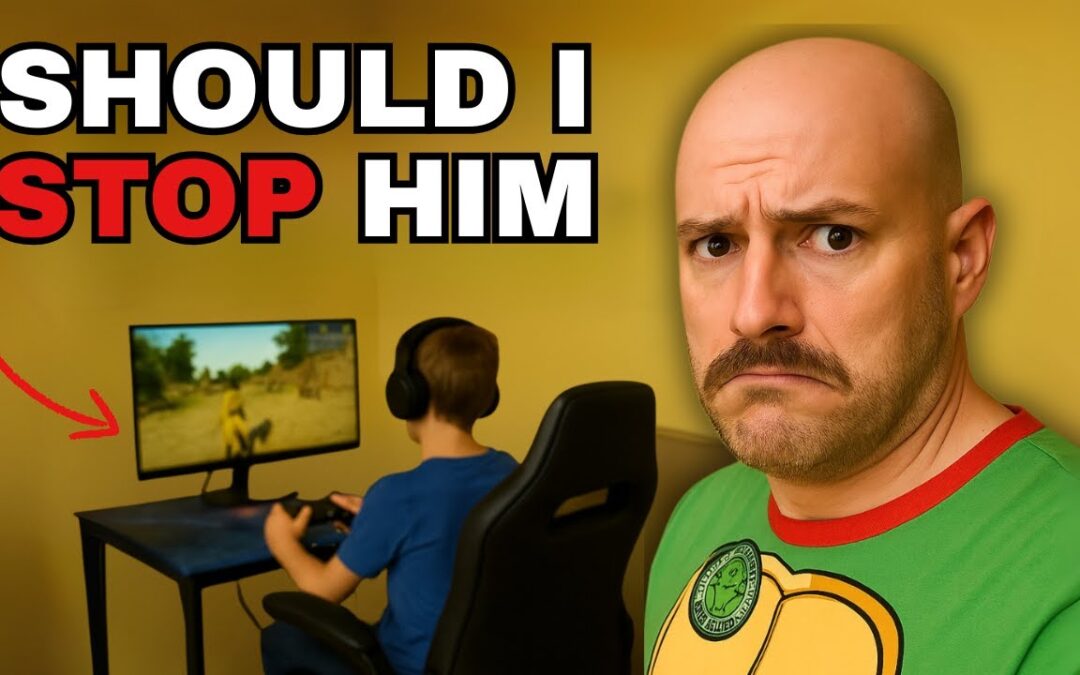
So the other day Tanner and I were in the house and I was asking him repeatedly not to do something and he just wasn’t listening. Being defiant. He’s six years old, he’s at that age where he’s testing everything, whatever, and obviously me as the best parent in the world I was obviously getting aggravated and after a little bit of time of constantly telling him hey do this, stop that, I need you to do this, he still wasn’t listening so I grounded him. Tablet, gaming, computer, all of it. First real grounding.
And then I watched him melt down and I started second-guessing myself. Did I go too hard? And that question kind of started this whole thing in my head about what we actually expect from our kids and whether we’re being fair about it.
I want to share three things that actually work better than punishment and that I’ve been using with Tanner, because I think a lot of parents — especially dads — nobody really talks about this stuff without it turning into either “be strict” or “be soft” and both of those camps miss the actual point.
We Forget What It Was Like to Be a Kid
Here’s the thing. I’m 40 years old and sometimes I still have a hard time keeping my emotions in check. And I mean that seriously. Like legitimately, I’ll catch myself getting frustrated about stuff and I know as an adult with a fully-developed brain that I’m being irrational, and I still struggle to stop it. So how are we expecting a six-year-old with a brain that is still literally developing to just instantly regulate when something feels unfair to them?
I think about my own dad a lot when this comes up. My dad’s a great dad, don’t get me wrong, but he was very much black and white about stuff. If he said something, it was done, no discussion, no second options, my way or the highway or whatever. And I get where that comes from — that generation just parented differently — but what I noticed growing up was that a lot of times I wasn’t actually learning the lesson. I was just learning not to get caught. You know what I’m trying to say? Those are two very different outcomes.
And so with Tanner, what I went back to after the grounding thing was this question — is he actually a bad kid, or is he a normal six-year-old who hit a moment where he needed something explained differently? And the answer was pretty obvious. Tanner’s a great kid 99% of the time. Helpful, shares with others, does what he’s told most of the time. Our kids are probably the number one people in the world who actually want to have a good healthy relationship with us. Think about that. I dunno any child that doesn’t want to be close with their parent. So when things go sideways, something else is usually happening.
The Three Things That Actually Work
1. Being Okay With Admitting You’re Wrong
So the first one is the hardest one for a lot of dads especially, which is being okay with admitting you don’t always get it right and being willing to actually pause and think before you react.
And I’m not going to pretend I always catch it in time. Sometimes I get aggravated. Sometimes I might ground Tanner prematurely or react to something before I’ve fully thought it through. But then what I try to do is turn it into a teaching moment — not that I was right, but like hey, even dad makes mistakes, and here’s what we do when we make mistakes, we own it and we try to fix it.
I don’t need to be Tanner’s superhero in the sense of being always right and never wrong. I need to be his superhero in the sense of showing him that growth matters more than being right. That it’s okay to go to people you love, admit you messed up, and ask for forgiveness. Because what he’s watching me model right now is what he’s going to carry into his own relationships for the rest of his life. That’s a lot of weight, and I try to remember that when I’m tempted to just dig into my position because I’m the dad and I said so.
The pause and think thing that helps me is asking — what’s just a normal kid reason he might be doing this? Because if I can find even one plausible reason that doesn’t involve him being a little monster on purpose, it immediately changes how I respond. And nine times out of ten there is one. Because kids aren’t usually trying to be malicious. They’re just kids with undeveloped brains trying to figure out how the world works.
2. The Family Team Approach
My go-to phrase with Tanner — and I use this constantly — is “we’re family, we’re supposed to help each other out.” Like, at the end of the day it’s me and you, bud. It’s me and you. This house has to be clean, things have to get done, and we’re the team that does it. If nobody else is going to help us out, we should be able to expect that from each other.
And I think what this does is it reframes the ask. Instead of “I’m the parent so you do what I say,” it becomes “we’re teammates and teammates help each other.” And I’m honest with him about it too. I’ll tell him I hate doing laundry. Like literally I hate doing laundry. I don’t want to do it either. But it has to get done, so we do it. And that helps him understand you don’t have to like something to do it, but you also don’t have to pretend it’s fun.
It’s not about lying to your kids and making everything sound great. It’s about being real with them in a way that meets them where they are. And I think kids actually respond to that honesty more than we give them credit for.
3. Meaningful Celebrations and Positive Reinforcement
Okay and I know what you’re thinking — here comes the “treat your kid like a dog” speech — and yeah, kind of, because positive reinforcement works. Not just with dogs. With humans. With adults. With all of us.
And it doesn’t have to cost money. I’m not saying you need to be buying your kid stuff every time he picks his socks off the floor. It could be hey if you help me today we’ll go for a hike, we’ll jump on the trampoline together, we’ll run down to the lake. Whatever your kid is into. The point is the celebration is specific and tied directly to the behavior you’re acknowledging. He knows why the good thing is happening. It’s not random. That connection matters.
And look, I still have strict boundaries. To be clear, nobody who talks about this stuff is saying don’t discipline your kids, let them do whatever they want, and they’ll just magically figure it out. That’s not the argument. The argument is in how you discipline, and specifically whether the discipline is actually teaching anything.
What I’ve Actually Seen Happen With Tanner
Here’s the real-world result. We constantly get comments from other adults about how well-behaved Tanner is. He’s respectful to adults. He does what he’s told most of the time. He can explain when he’s upset without losing his temper — like he’s actually learned to do that over the last couple years. He doesn’t throw controllers or break things when he’s frustrated, and I’ve seen other kids do that and it’s not pretty.
And here’s the wild part. When I was in court during the custody case, his mom testified that at her house he’s disrespectful, yells, screams, doesn’t listen, throws chairs and stuff. And I got up and I told the judge honestly, I have no idea what you’re talking about because at my house he doesn’t do any of that. Same exact kid. Two completely different results. And I’m not saying I’m a better parent in some broad sense. I’m saying something about the environment and the approach is creating a very different experience.
Same kid. Different results. That’s not a coincidence, and it’s not something I’m bragging about — it’s something I think is worth paying attention to because the method matters.
My Actual Discipline Approach When It’s Needed
Because I don’t want this to sound like I never discipline Tanner, because I do, here’s how I actually handle it when something needs consequences.
I explain the why at his level. And yeah, that takes more time than just saying “because I said so.” But it works better. I try to get down and explain it in a way that actually makes sense to a six-year-old brain because kids are naturally curious and they’re just trying to figure out the world. They don’t know what happens when they tell you no until they do it for the first time. If you can explain the importance of why, nine times out of ten Tanner just gets it and the situation’s over.
It’s okay for him to know I’m angry. I don’t pretend I’m not frustrated. But I make sure he understands the distinction — you’re not being grounded because I’m angry, you’re being grounded because you’re not doing this specific thing I’m asking you to do. Anger and consequence are two separate things and I want him to understand both.
And when new evidence shows up — when he’s remorseful, when he clearly understood the lesson — I’m willing to change my mind. I ungrounded him that same day after we talked because the lesson was already learned. Why continue the punishment past the point where learning happened? That’s not teaching anymore, that’s just punishment for its own sake.
Growth matters more than being right. That’s kind of the whole philosophy in one sentence.
What to Actually Try Tonight
If you’re someone who feels like you’re constantly yelling and your kid is constantly not listening and the whole thing feels like a war, here’s a very small practical thing to try. Tonight, pick an activity that requires very minimal thinking. A puzzle, a board game, something like the card-matching game Tanner loves where you flip over cards and try to find the pairs. Something easy and slow that gives you room to have a conversation without the activity itself taking all your attention.
And during that, you say hey I wanted to talk to you about something. And you use that space to tell them you’re not perfect, you mess up sometimes, and here’s what you want to try to do differently. Come up with a phrase between you and your kid — something they can say to you when you’re losing it that won’t make you angrier, just something that helps you remember to pause.
Don’t expect overnight transformation. That’s not realistic. But turn it into a process you’re both working on together, where you’re both trying to get better at this stuff. Because honestly, parenting is one of those things where the more I think I know, the more I realize I’m still figuring it out. The same thing I’m trying to teach Tanner — that growth matters more than being right — is the exact same thing I have to keep teaching myself.
Try the puzzle thing tonight. Then come back and leave a comment and let me know how it went. I genuinely want to hear what your kid said, what surprised you. Because I bet if you actually take the time to do it, you’ll be surprised.
And if any of this resonated with you, especially the custody stuff or the co-parenting dynamics, I talk about that a lot more on the channel — subscribe and stick around because I share the real version of what dad life actually looks like, not the highlight reel.